Scholarly Sources:
Stever, Gayle. “Fan Behavior and Lifespan Development Theory: Explaining Para- Social and Social Attachment to Celebrities.” Journal of Adult Development, vol. 18, no. 1, Mar. 2011, pp. 1–7. EBSCOhost, doi:10.1007/s10804-010-9100-0
This article looks at the significance of feeling an attachment to a celebrity during our teenage years and how it affects our development.
This article is important because it offers an in-depth analysis on why people feel attached to celebrities. One of the main factors that drew me to write about this topic is the question of why people shame others for mourning celebrities. This article didn’t explain why people do that, but it did show me that developing an attachment to a celebrity is not only normal, but it is an important part of our psychological development. People chose to develop “relationships” with celebrities to satisfy certain psychosocial needs.
Katie Z. Gach, Casey Fiesler, Jed R. Brubaker. “‘Control your emotions, Potter’: An Analysis of Grief Policing on Facebook in Response to Celebrity Death.” ACM Digital Library, vol. 1, no. 2, Nov. 2017, pp. 1–13. https://doi.org/10.1145/3134682
This study analyzes the public Facebook comments about celebrity deaths (specifically the deaths of Alan Rickman, David Bowie, and Prince) and the motives behind people commenting.
This study stuck with me because it answers a question similar to my question of why people shut down those publicly mourning. It touches more on the subject of why people have conflicts on social media surrounding celebrity deaths when both parties are mourning rather than someone getting shamed for mourning. The article basically comes to the conclusion that the main reason that people clash in the comments is because they disagree on how to mourn, which I find ridiculous. Mourning is the kind of thing that varies greatly from person to person. The disagreements on how to cope were described by the authors as being because people were “importing norms from other contexts when shared spaces consist of transient interactions that make norm formation difficult.”
Non-Scholarly Sources:
Holmes, Lindsay. “Why Do Celebrity Deaths Feel So Personal?” HuffPost Canada, HuffPost Canada, 31 Jan. 2020, www.huffingtonpost.ca/entry/mourning-prince-why-we-grieve-celebrity-deaths-grief_n_57190ba4e4b0d4d3f722974a.
This article summarizes a certified counsellor’s explanation of why we feel so sad about the passing of celebrities.
This article was the first one I came across during my research and really helped shape my understanding of the topic. It opened my thought process to angles I would never consider because that isn’t the way I think. Although it isn’t a scholarly article, the article does present an expert’s opinion on many different reasons why we feel so sad when celebrities die. He mentions the importance of grieving however you deem fit, while still being respectful.
Nelson, Brooke. “This Powerful Story Will Convince You to Stop Posting ‘RIP’ on Social Media.” Reader’s Digest, 18 July 2017, www.rd.com/advice/relationships/ grieving-on-social-media/.
This article recounts an anecdote of a woman who just lost her husband and how social media posts about him were an added stress.
This article is important because it shows how people on the receiving end of these comments react. While the comments might not be negative, the effects might be. This article got me to look at posting on social media about death from a different perspective. It brought up the point of why you shouldn’t post about someone’s death on social media especially if those closest to the deceased haven’t done so, which I connected to how literally millions of people posted about Kobe’s death before his wife even said anything. On top of that, Kobe’s eldest daughter found out about his passing through social media, and the lack of respect for his family surrounding social media posts was a big issue.
Cultural Artifact
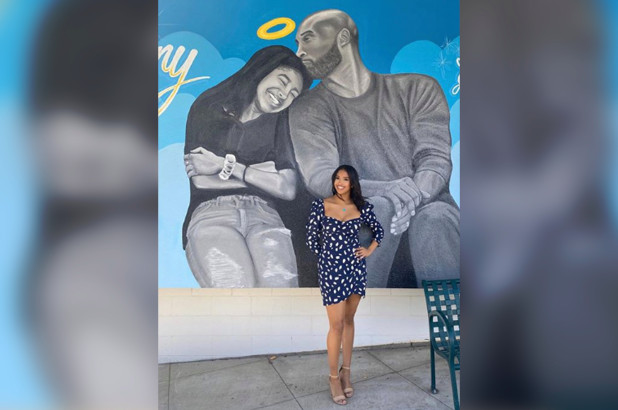
Here, Kobe’s daughter Natalia poses in front of a mural of her father and Sister in an Instagram post made by her mother.
This picture really tugs at the heartstrings, because it shows that she their family is staying strong and doing well. Especially when mourning a celebrity it’s easy to think selfishly and to somehow forget that your pain isn’t the worst. Kobe’s family kept their grief process very private, and this post is a reminder that they’re doing well and that as fans, we should be too.
Experiential Research
When Kobe Bryant died, I was truly devastated.
I think the most important experience relating to this topic is how I felt when Kobe died. I couldn’t understand why I felt so terrible because I’ve never met Kobe. Even though I only watched him play basketball and give interviews, I really felt like I knew him and I felt like I was grieving as if I mourned him. I soon found out that my close friends were feeling the same way. My lack of understanding for why our feelings of sadness were all-consuming and so intense is what lead me to take on this topic.
In class, when I mentioned my possible topic to my teacher, he brought up how he also felt very sad. He said he even cried, and doesn’t even watch basketball.
When I had that conversation, I realized that I had found a subject that was really interesting. I knew that the basketball community was devastated at the loss of Kobe, but for someone that isn’t a hardcore basketball fan to cry means that these celebrities have a much bigger reach than I expected, and their passing can mean much more to people than I could have imagined. If his death was enough to genuinely affect an English teacher in Montreal that doesn’t watch basketball, imagine how someone that grew up in LA watching and idolizing Kobe while he played for the Lakers must have felt.
 Ben's Nonfiction Blog